It is precisely among the heretics of every age that we find men who were filled with this highest kind of religious feeling and were in many cases regarded by their contemporaries as atheists, sometimes also as saints.
I believe in Spinoza’s God, Who reveals Himself in the lawful harmony of the world, not in a God Who concerns Himself with the fate and the doings of mankind.
I can understand your aversion to the use of the term ‘religion’ to describe an emotional and psychological attitude which shows itself most clearly in Spinoza… I have not found a better expression than ‘religious’ for the trust in the rational nature of reality that is, at least to a certain extent, accessible to human reason.
I believe that whatever we do or live for has its causality; it is good, however, that we cannot see through to it. [Interview with Rabindranath Tagore (14 April 1930)] All religions, arts and sciences are branches of the same tree… Our time is distinguished by wonderful achievements in the fields of scientific understanding and the technical application of those insights. Who would not be cheered by this? But let us not forget that human knowledge and skills alone cannot lead humanity to a happy and dignified life. Humanity has every reason to place the proclaimers of high moral standards and values above the discoverers of objective truth. What humanity owes to personalities like Buddha, Moses, and Jesus ranks for me higher than all the achievements of the enquiring and constructive mind.
I am enough of an artist to draw freely upon my imagination. Imagination is more important than knowledge. Knowledge is limited. Imagination encircles the world. How can cosmic religious feeling be communicated from one person to another, if it can give rise to no definite notion of a God and no theology? In my view, it is the most important function of art and science to awaken this feeling and keep it alive in those who are receptive to it. The most beautiful experience we can have is the mysterious. It is the fundamental emotion that stands at the cradle of true art and true science. Whoever does not know it and can no longer wonder, no longer marvel, is as good as dead, and his eyes are dimmed. It was the experience of mystery — even if mixed with fear — that engendered religion. A knowledge of the existence of something we cannot penetrate, our perceptions of the profoundest reason and the most radiant beauty, which only in their most primitive forms are accessible to our minds: it is this knowledge and this emotion that constitute true religiosity. In this sense, and only this sense, I am a deeply religious man. I believe in mystery and, frankly, I sometimes face this mystery with great fear. In other words, I think that there are many things in the universe that we cannot perceive or penetrate, and that also we experience some of the most beautiful things in life only in a very primitive form. Only in relation to these mysteries do I consider myself to be a religious man…. Science without religion is lame, religion without science is blind. Science, in the immediate, produces knowledge and, indirectly, means of action. It leads to methodical action if definite goals are set up in advance. For the function of setting up goals and passing statements of value transcends its domain. While it is true that science, to the extent of its grasp of causative connections, may reach important conclusions as to the compatibility and incompatibility of goals and evaluations, the independent and fundamental definitions regarding goals and values remain beyond science’s reach. As regards religion, on the other hand, one is generally agreed that it deals with goals and evaluations and, in general, with the emotional foundation of human thinking and acting, as far as these are not predetermined by the inalterable hereditary disposition of the human species. Religion is concerned with man’s attitude toward nature at large, with the establishing of ideals for the individual and communal life, and with mutual human relationship. These ideals religion attempts to attain by exerting an educational influence on tradition and through the development and promulgation of certain easily accessible thoughts and narratives (epics and myths) which are apt to influence evaluation and action along the lines of the accepted ideals. What is the meaning of human life, or of organic life altogether? To answer this question at all implies a religion. Is there any sense then, you ask, in putting it? I answer, the man who regards his own life and that of his fellow creatures as meaningless is not merely unfortunate but almost disqualified for life.
Nothing truly valuable arises from ambition or from a mere sense of duty; it stems rather from love and devotion towards men and towards objective things. I’m not an atheist and I don’t think I can call myself a pantheist. We are in the position of a little child entering a huge library filled with books in many different languages. The child knows someone must have written those books. It does not know how. The child dimly suspects a mysterious order in the arrangement of the books but doesn’t know what it is. That, it seems to me, is the attitude of even the most intelligent human being toward God. We see a universe marvelously arranged and obeying certain laws, but only dimly understand these laws. Our limited minds cannot grasp the mysterious force that moves the constellations. I am fascinated by Spinoza’s pantheism, but admire even more his contributions to modern thought because he is the first philosopher to deal with the soul and the body as one, not two separate things. I have always believed that Jesus meant by the Kingdom of God the small group scattered all through time of intellectually and ethically valuable people. The world is a dangerous place to live, not because of the people who are evil, but because of the people who don’t do anything about it.
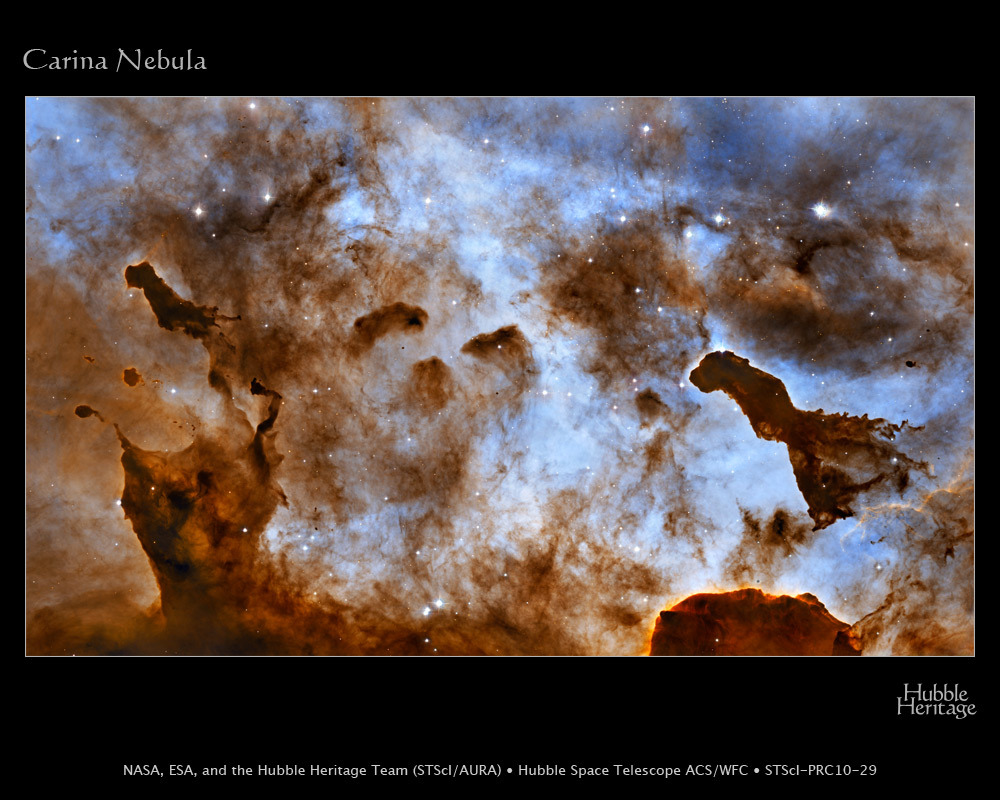
Cosmic Ice Sculptures: Dust Pillars in the Carina Nebula
Enjoying a frozen treat on a hot summer day can leave a sticky mess as it melts in the Sun and deforms. In the cold vacuum of space, there is no edible ice cream, but there is radiation from massive stars that is carving away at cold molecular clouds, creating bizarre, fantasy-like structures.
These one-light-year-tall pillars of cold hydrogen and dust, imaged by the Hubble Space Telescope, are located in the Carina Nebula. Violent stellar winds and powerful radiation from massive stars are sculpting the surrounding nebula. Inside the dense structures, new stars may be born.
This image of dust pillars in the Carina Nebula is a composite of 2005 observations taken of the region in hydrogen light along with 2010 observations taken in oxygen light, both times with Hubble’s Advanced Camera for Surveys. The immense Carina Nebula is an estimated 7,500 light-years away in the southern constellation Carina. Credit: NASA, ESA, and the Hubble Heritage Project (STScI/AURA)
Credit: NASA, ESA, and the Hubble Heritage Team (STScI/AURA)
Acknowledgment: M. Livio (STScI) and N. Smith (University of California, Berkeley)
 Gatlinburg Garden Castle Rainbow Tower Library Imagination Station Temple Water Spirit Guardian Labyrinth Treasury Magic Healing
Leave a comment