“Once we overcome our fear of being tiny, we find ourselves on the threshold of a vast and awesome Universe that utterly dwarfs — in time, in space, and in potential — the tidy anthropocentric proscenium of our ancestors. We gaze across billions of light-years of space to view the Universe shortly after the Big Bang, and plumb the fine structure of matter. We peer down into the core of our planet, and the blazing interior of our star. We read the genetic language in which is written the diverse skills and propensities of every being on Earth. We uncover hidden chapters in the record of our origins, and with some anguish better understand our nature and prospects. We invent and refine agriculture, without which almost all of us would starve to death. We create medicines and vaccines that save the lives of billions. We communicate at the speed of light, and whip around the Earth in an hour and a half. We have sent dozens of ships to more than seventy worlds, and four spacecraft to the stars. We are right to rejoice in our accomplishments, to be proud that our species has been able to see so far, and to judge our merit in part by the very science that has so deflated our pretensions.”
– Carl Sagan, Pale Blue Dot (1994)
http://en.wikiquote.org/wiki/Carl_Sagan
http://en.wikipedia.org/wiki/Pale_Blue_Dot
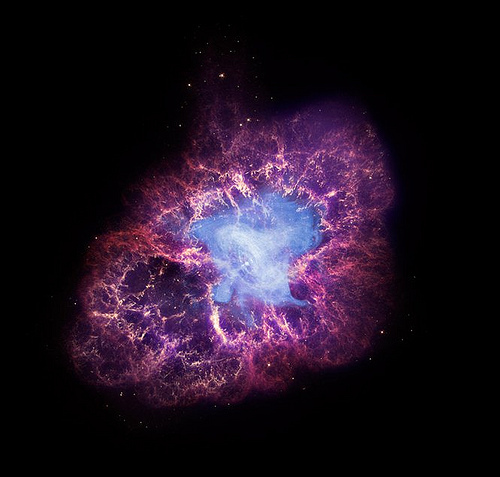
“A star’s spectacular death in the constellation Taurus was observed on Earth as the supernova of 1054 A.D. Now, almost a thousand years later, a super dense object — called a neutron star — left behind by the explosion is seen spewing out a blizzard of high-energy particles into the expanding debris field known as the Crab Nebula. X-ray data from Chandra provide significant clues to the workings of this mighty cosmic “generator,” which is producing energy at the rate of 100,000 suns.
This composite image uses data from three of NASA’s Great Observatories. The Chandra X-ray image is shown in blue, the Hubble Space Telescope optical images are in yellow and red, and the Spitzer Space Telescope’s infrared image is in purple. The X-ray image is smaller than the others because extremely energetic electrons emitting X-rays radiate away their energy more quickly than the lower-energy electrons emitting optical and infrared light. Along with many other telescopes, Chandra has repeatedly observed the Crab Nebula over the course of the mission’s lifetime. The Crab Nebula is one of the most studied objects in the sky, truly making it a cosmic icon.
Read entire caption/view more images: chandra.harvard.edu/photo/2009/crab/
Image credit: X-ray: NASA/CXC/SAO/F.Seward; Optical: NASA/ESA/ASU/J.Hester & A.Loll; Infrared: NASA/JPL-Caltech/Univ. Minn./R.Gehrz
Caption credit: Harvard-Smithsonian Center for Astrophysics
Read more about Chandra:
www.nasa.gov/chandra
p.s. You can see all of our Chandra photos in the Chandra Group in Flickr at: www.flickr.com/groups/chandranasa/ We’d love to have you as a member!”
 Gatlinburg Garden Castle Rainbow Tower Library Imagination Station Temple Water Spirit Guardian Labyrinth Treasury Magic Healing
Leave a comment