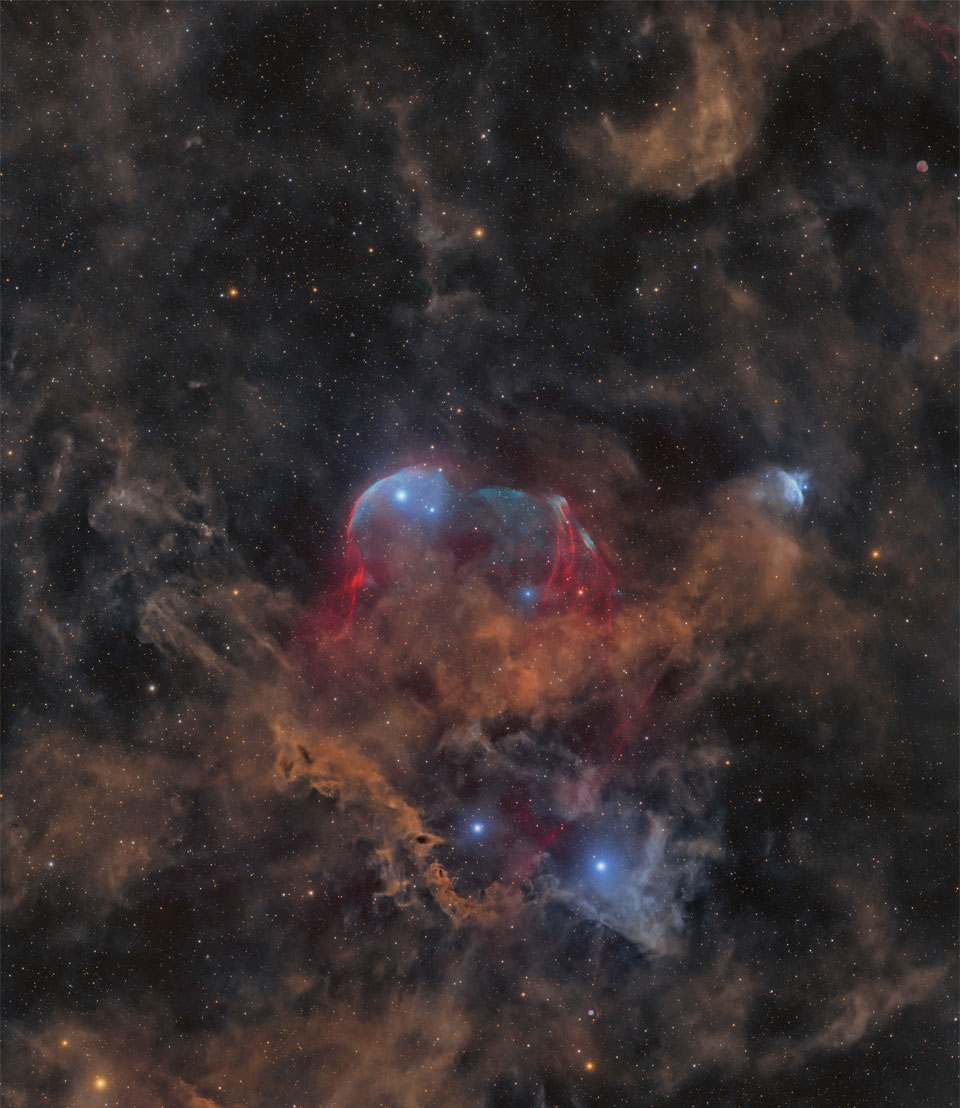
Can you identify this celestial object? Likely not — because this is a discovery image. Massive stars forge heavy elements in their cores and, after a few million years, end their lives in powerful supernova explosions. These remnants cool relatively quickly and fade, making them difficult to detect. To uncover such faint, previously unknown supernova remnants, a dedicated group of amateur astrophotographers searched through sky surveys for possible supernova remnant candidates. The result: the first-ever image of supernova remnant G115.5+9.1 — named Scylla by its discoverers—glowing faintly in the constellation of the mythological King of Aethiopia: Cepheus. Emission from hydrogen atoms in the remnant is shown in red, and faint emission from oxygen is shown in hues of blue. Surprisingly, another discovery lurked to the upper right: a faint, previously unknown planetary nebula candidate. In keeping with mythological tradition, it was named Charybdis (Sai 2) — a nod to the ancient Greek expression “caught between Scylla and Charybdis” from Homer’s Odyssey. via NASA https://ift.tt/T4Ffm6q Click here
from Blogger https://ift.tt/Kcj9XFM
nasa
 Gatlinburg Garden Castle Rainbow Tower Library Imagination Station Temple Water Spirit Guardian Labyrinth Treasury Magic Healing
Leave a comment