https://www.youtube.com/watch/r5EL_cmM7YY Trump’s Bonkers Message to Norway Over Greenland; Nobel Committee’s Response to Trump: A Closer Look
Seth takes a closer look at Trump sending a message to Norway complaining that he didn’t win the Nobel Peace Prize and threatening to invade Greenland.
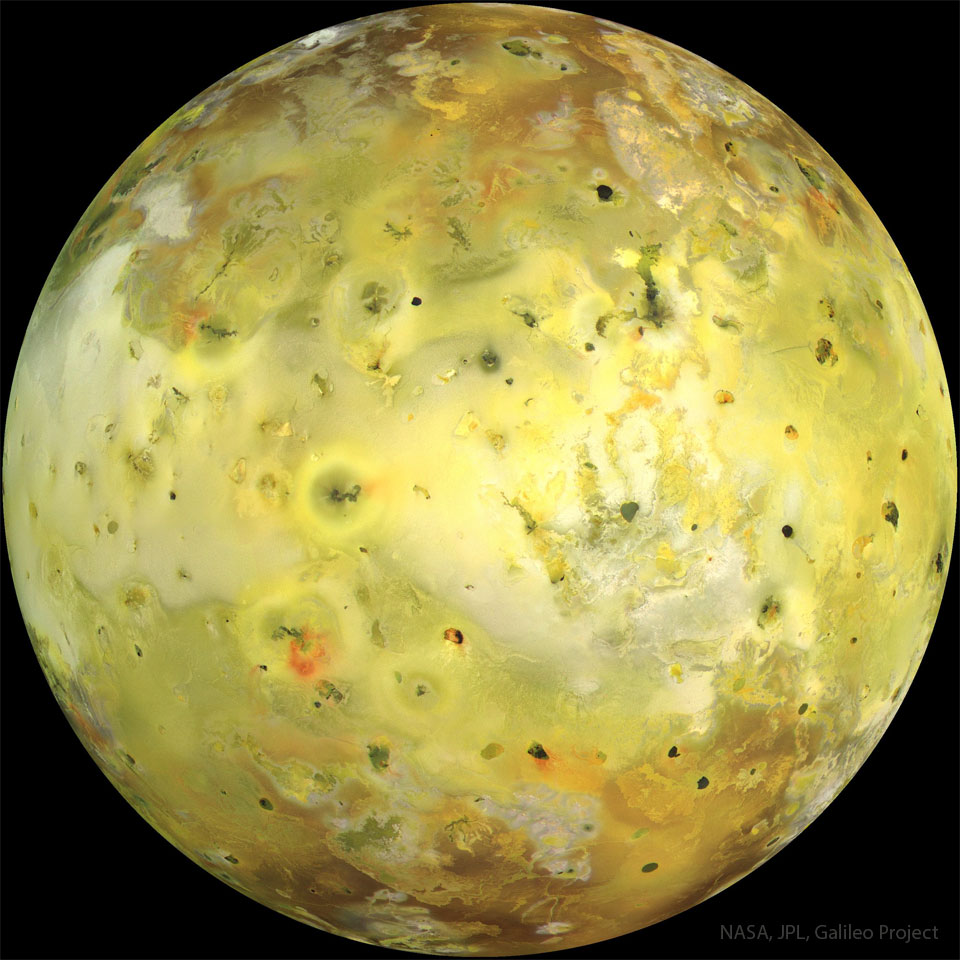
The strangest moon in the Solar System is bright yellow. The featured picture, an attempt to show how Io would appear in the “true colors” perceptible to the average human eye, was taken in 1999 July by the Galileo spacecraft that orbited Jupiter from 1995 to 2003. Io’s colors derive from sulfur and molten silicate rock. The unusual surface of Io is kept very young by its system of active volcanoes. The intense tidal gravity of Jupiter stretches Io and damps wobbles caused by Jupiter’s other Galilean moons. The resulting friction greatly heats Io’s interior, causing molten rock to explode through the surface. Io’s volcanoes are so active that they are effectively turning the whole moon inside out. Some of Io’s volcanic lava is so hot it glows in the dark. via NASA https://ift.tt/Mimd7ck
https://www.youtube.com/watch/TJZ-UFyA89Y Nick Cave confronts the ‘disgraceful self-indulgence’ of his past | Australian Story
From drug-addicted hellraiser to besuited grandfather – the evolution of rock star Nick Cave
About Australian Story: The power of the personal. Compelling stories about real people that illuminate, entertain and inspire. New episodes are available every Wednesday on YouTube.
Welcome to ABC News In-depth, where you’ll find our long-form journalism and other videos to help you understand what’s going on in the world around you.
https://www.youtube.com/watch/nNhDqHDnp74 Trump’s demands put Europe in FAFO territory | Ian Bremmer’s Quick Take
Checking in from the 2026 World Economic Forum in Davos, Ian Bremmer breaks down a deepening crisis in the transatlantic relationship as President Trump escalates pressure on Europe over Greenland.
With European leaders already stretched by the war in Ukraine, economic underperformance, and questions about US reliability, Trump’s renewed insistence that the United States must own Greenland has become a defining test of whether Europe can push back, or whether it fractures under pressure.
As Ian explains, the stakes go far beyond trade disputes or Arctic security:
“Trump is coming to Davos to meet with a lot of European leaders at a time when he is threatening to rip up the transatlantic alliance and to engage in undermining the territorial integrity of one of its closest, albeit small, allies. Now, if that’s the way this ends up, it’s the end of NATO.”
Ian also unpacks his framework for understanding Trump’s foreign policy approach: FAFO vs. TACO, and why countries that can credibly push back fare far better than those that can’t.
Ian breaks down what Greenland reveals about leverage, alliance politics, and whether Europe is capable of acting as a unified power in a rapidly fragmenting global order.
GZERO Media, a Eurasia Group company, is a multimedia publisher providing news, insights, and commentary on the events shaping our world. Our properties include GZERO World with Ian Bremmer, our weekly show on US public television; our newsletters GZERO Daily, GZERO AI, GZERO North, and GZERO Daily with Ian Bremmer; our parody series Puppet Regime; our digital video series including Ian Bremmer’s Quick Take every week; and the GZERO World Podcast. Our content is free and available at https://ift.tt/Ak3Vt5r.
https://www.youtube.com/watch/sFXzlUhKymM Why Trump is pushing to take Greenland | Ian Bremmer’s Quick Take
Ian Bremmer breaks down a sudden and serious transatlantic crisis: President Trump’s insistence that the United States must have sovereignty over Greenland.
This is not a negotiation over security guarantees, expanded US bases, or Arctic cooperation, all which Denmark and Greenland have said they would accommodate. Instead, Washington has drawn a red line: no deal unless the US owns Greenland outright. That position, reinforced by Vice President JD Vance and Secretary of State Marco Rubio, has triggered threats of tariffs against European countries supporting Denmark and raised questions about America’s reliability inside NATO.
European leaders believe this push isn’t really about security or critical minerals. Ian says many see it as a legacy play driven by Trump’s ego and something Greenlanders would never vote for and Denmark will not accept. The deeper risk, Ian warns, is structural: “The more the United States unilaterally undermines the collective security trust of NATO, the stronger the argument becomes that only American territory is truly protected.”
The bigger risk is strategic: by undermining allied trust, the US strengthens the argument that only American territory receives ironclad protection. That logic may appeal in Washington, but it accelerates fragmentation inside NATO and the EU.
With Trump and European leaders heading to Davos, the question is whether diplomacy can produce a climbdown, or whether Greenland becomes the next major rupture in the global order.
GZERO Media, a Eurasia Group company, is a multimedia publisher providing news, insights, and commentary on the events shaping our world. Our properties include GZERO World with Ian Bremmer, our weekly show on US public television; our newsletters GZERO Daily, GZERO AI, GZERO North, and GZERO Daily with Ian Bremmer; our parody series Puppet Regime; our digital video series including Ian Bremmer’s Quick Take every week; and the GZERO World Podcast. Our content is free and available at https://ift.tt/Ak3Vt5r.
https://www.youtube.com/watch/_DL3TGka9EA Trump’s foreign policy is reshaping the world order | GZERO World with Ian Bremmer
President Trump’s second term has rapidly reshaped global politics, with the US wielding power more aggressively, targeting weaker countries and even allies, Stephen Walt explains on GZERO World.
How has President Trump reshaped the world since returning to office one year ago? Harvard’s Stephen Walt joins Ian Bremmer on GZERO World to discuss the biggest changes to the global order as Trump aggressively expands executive power and pushes a much more muscular view of US foreign policy. The general direction of Trump’s policies may not necessarily be a surprise, Walt says, but the “speed and scope” of changes is—from aggressive tariffs and pressure on allies to a willingness to use military force abroad.
Power asymmetry now defines US foreign policy, with weaker countries bearing the brunt of Trump’s military and economic pressure, while rivals like Russia and China face far less hostility. Walt calls this view of the world “predatory hegemony.” All great powers are predators to some degree, but what makes Trump’s foreign policy different is his willingness to target US allies.
GZERO Media, a Eurasia Group company, is a multimedia publisher providing news, insights, and commentary on the events shaping our world. Our properties include GZERO World with Ian Bremmer, our weekly show on US public television; our newsletters GZERO Daily, GZERO AI, GZERO North, and GZERO Daily with Ian Bremmer; our parody series Puppet Regime; our digital video series including Ian Bremmer’s Quick Take every week; and the GZERO World Podcast. Our content is free and available at https://ift.tt/Ak3Vt5r.
https://www.youtube.com/watch/H_RiQchMZxw One year into Trump 2.0: How the world has changed | GZERO World with Ian Bremmer
It’s been a year since President Trump returned to office. How has the world changed? Stephen Walt joins Ian Bremmer on GZERO World.
In just 12 months, Donald Trump has transformed the presidency—and the world. He returned to the White House with fewer constraints and a more muscular view of foreign policy. Stephen Walt, professor of international affairs at Harvard’s Kennedy School joins Ian Bremmer on GZERO World for a look at President Trump’s first year back in office and what comes next.
President Trump has been able to swiftly reshape the government to fit his worldview. The presidency is more powerful. Alliances are more conditional. And the rules of the global order are being redefined in real time. Is this a permanent rewrite of how the United States uses power going forward? This week on GZERO World, one-year check-in on Trump’s second act and what it’s already changed, both at home and abroad.
GZERO Media, a Eurasia Group company, is a multimedia publisher providing news, insights, and commentary on the events shaping our world. Our properties include GZERO World with Ian Bremmer, our weekly show on US public television; our newsletters GZERO Daily, GZERO AI, GZERO North, and GZERO Daily with Ian Bremmer; our parody series Puppet Regime; our digital video series including Ian Bremmer’s Quick Take every week; and the GZERO World Podcast. Our content is free and available at https://ift.tt/Ak3Vt5r.
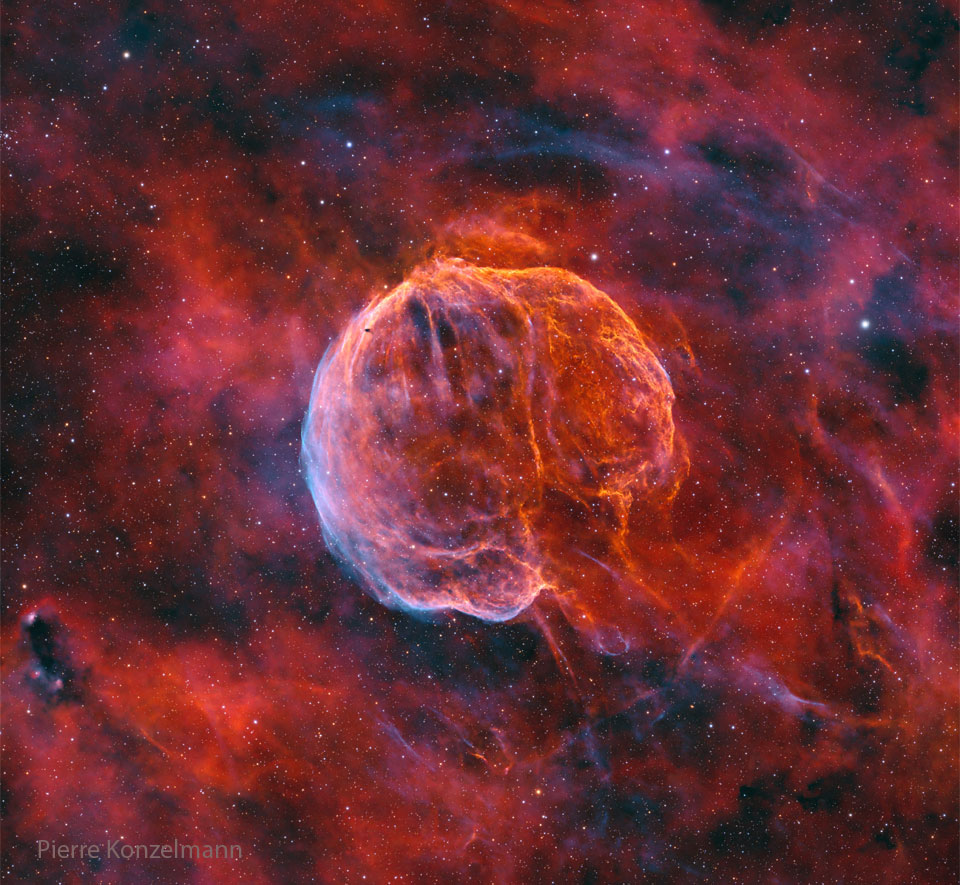
What powers this unusual nebula? CTB 1 is the expanding gas shell that was left when a massive star toward the constellation of Cassiopeia exploded about 10,000 years ago. The star likely detonated when it ran out of elements, near its core, that could create stabilizing pressure with nuclear fusion. The resulting supernova remnant, nicknamed the Medulla Nebula for its brain-like shape, still glows in visible light because of the heat generated by its collision with confining interstellar gas. Why the nebula also glows in X-ray light, though, remains a topic of research. One hypothesis holds that an energetic pulsar was created and powers the nebula with a fast outwardly moving wind. Following this lead, a pulsar was found in radio waves that appears to have been expelled by the supernova explosion at over 1000 kilometers per second. Although the Medulla Nebula appears as large as a full moon, it is so faint that it took 84-hours of exposure with a small telescope in Texas, USA, to create the featured image. via NASA https://ift.tt/CK9ITry
https://www.youtube.com/watch/Du7nKnKhhmU Cocteau Twins – Aikea-Guinea (Official Video)
‘Aikea-Guinea’ by Cocteau Twins features on their 1986 album ‘The Pink Opaque’ and the 1985 ‘Aikea-Guinea’ EP.
This infrared view of Jupiter by Webb is illuminating. High-resolution infrared images of Jupiter from the James Webb Space Telescope (Webb) reveal, for example, differences between high-floating bright clouds — including the Great Red Spot — and low-lying dark clouds. Also clearly visible in the featured Webb image are Jupiter’s dust ring, bright auroras at the poles, and Jupiter’s moons Amalthea and Adrastea. The footprint of large volcanic moon Io’s magnetic funneling of charged particles onto Jupiter is also visible in the southern aurora. Some objects are so bright that light noticeably diffracts around Webb’s optics creating streaks. Webb, which orbits the Sun near the Earth, has a mirror over six meters across making it the largest astronomical telescopeever launched — with over six times more light-collecting area than Hubble. via NASA https://ift.tt/2bhFu1v