https://www.youtube.com/watch/e3ONHh1kQ98 Europe takes control of Ukraine’s future | Ian Bremmer’s Quick Take
In his latest Quick Take, Ian Bremmer explains a major shift in the Ukraine war: Europe, not the United States, is now driving the strategy.
The EU has agreed to indefinitely freeze $247 billion in Russian assets, unlocking Belgian support for a nearly $200 billion loan to Ukraine. This guarantees Kyiv enough funding to continue fighting for years, regardless of what Washington does.
It also means Europe and Ukraine, not the US, will have more say over the war’s future. For the Trump administration, avoiding responsibility outweighs shaping the outcome.
But Europe faces vulnerabilities: slow growth, fragmented politics, weak defense capacity, and US pressure backing Euroskeptic movements. Whether the EU strengthens into a true geopolitical “pole,” or fragments, will shape the post–G-zero world.
GZERO Media, a Eurasia Group company, is a multimedia publisher providing news, insights, and commentary on the events shaping our world. Our properties include GZERO World with Ian Bremmer, our weekly show on US public television; our newsletters GZERO Daily, GZERO AI, GZERO North, and GZERO Daily with Ian Bremmer; our parody series Puppet Regime; our digital video series including Ian Bremmer’s Quick Take every week; and the GZERO World Podcast. Our content is free and available at https://bit.ly/4fd0tst.
https://www.youtube.com/watch/Ts5VXmjWhJ8 Trump Air Force One Press Conference Cold Open – SNL
President Donald Trump (James Austin Johnson) hosts a press conference aboard Air Force One.
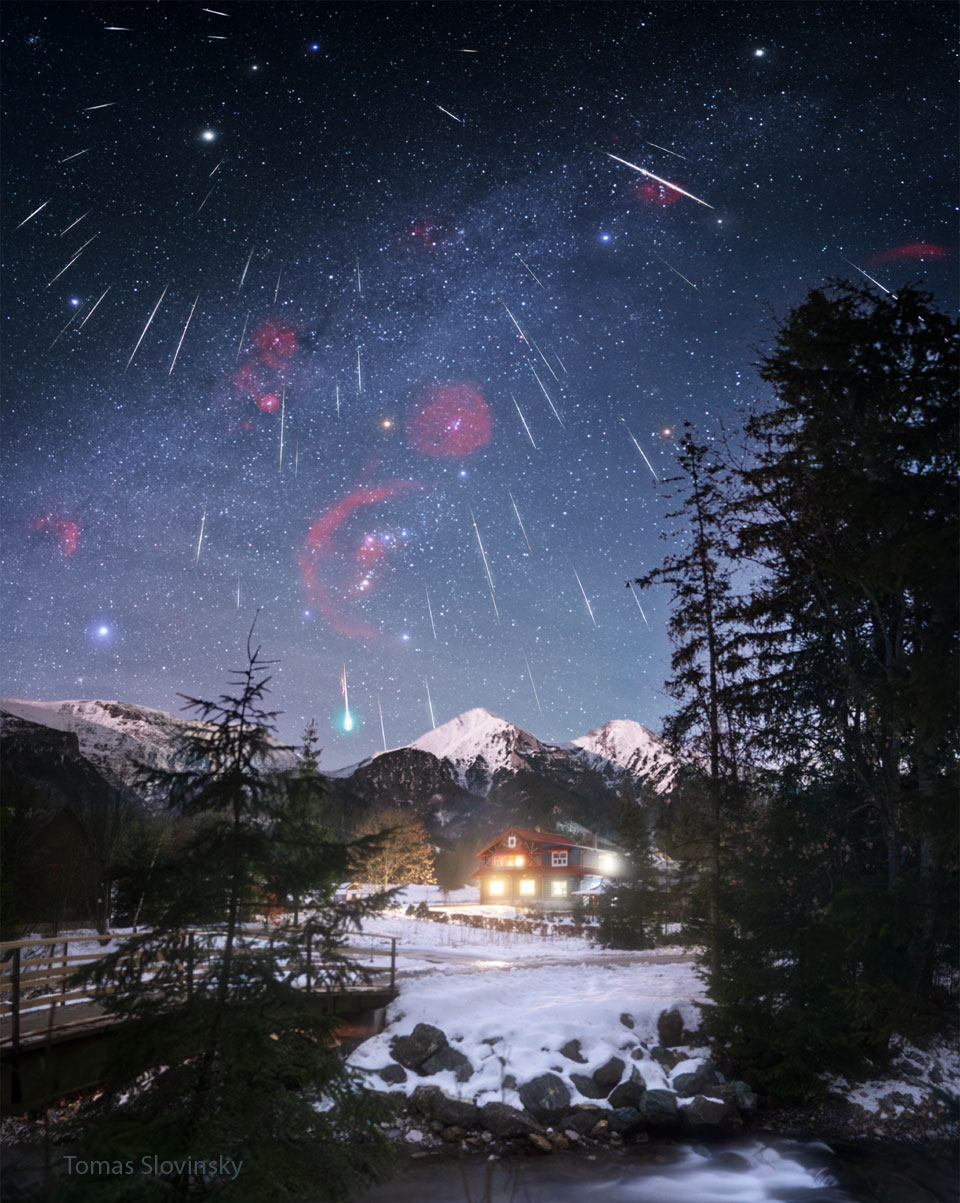
Where are all of these meteors coming from? In terms of direction on the sky, the pointed answer is the constellation of Gemini. That is why the major meteor shower in December is known as the Geminids — because shower meteors all appear to come from a radiant toward Gemini. Three dimensionally, however, sand-sized debris expelled from the unusual asteroid 3200 Phaethon follows a well-defined orbit about our Sun, and the part of the orbit that approaches Earth is superposed in front of the constellation of Gemini. Therefore, when Earth crosses this orbit, the radiant point of falling debris appears in Gemini. Featured here is a composite of many images taken over the past few days through dark skies from Slovakia and capturing the snow-covered peaks of the Belianske Tatra mountains Numerous bright meteor streaks from the Geminids meteor shower are visible. Orion is visible above the horizon, while the bright star nearest the radiant is Castor. via NASA https://go.nasa.gov/4pEmwOI
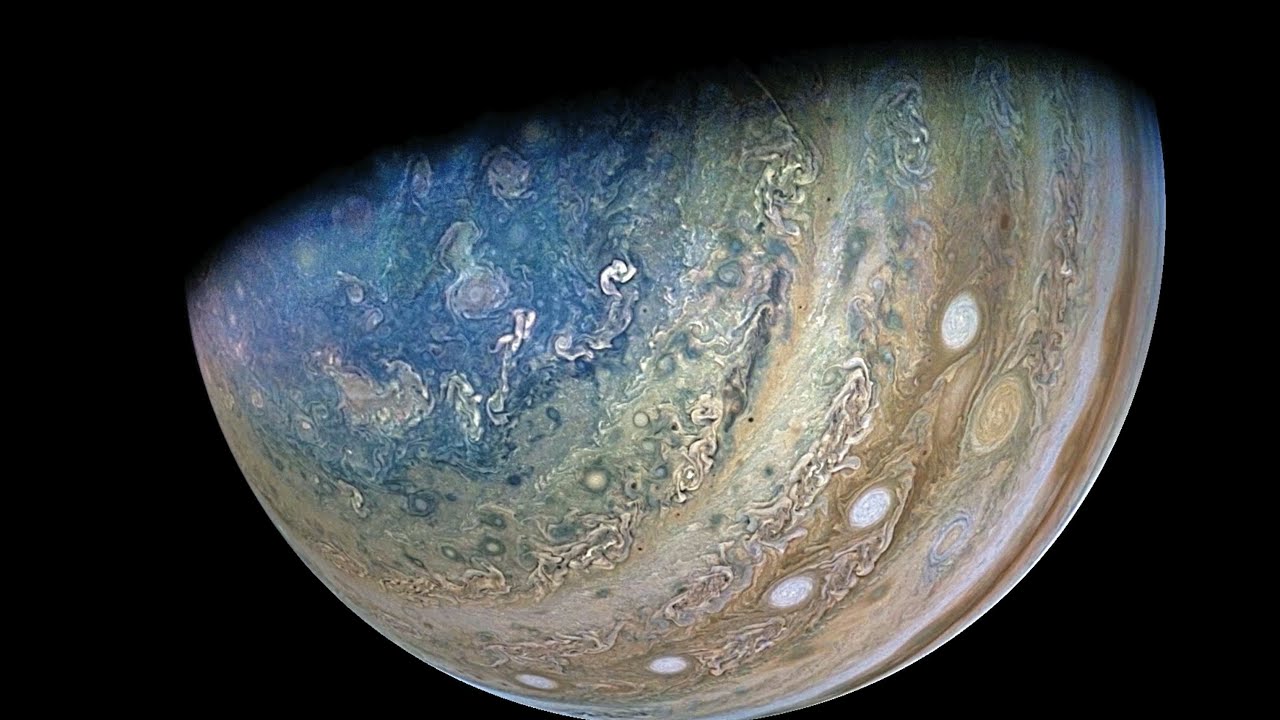
What would it be like to fly over the largest moon in the Solar System? In 2021, the robotic Juno spacecraft flew past Jupiter’s huge moon Ganymede and took images that have been digitally constructed into a detailed flyby. As the featured video begins, Juno swoops over the two-toned surface of the 2,000-km wide moon, revealing an icy alien landscape filled with grooves and craters. The grooves are likely caused by shifting surface plates, while the craters are caused by violent impacts. Continuing on in its orbit, Juno then performed its 34th close pass over Jupiter’s clouds. The digitally-constructed video shows numerous swirling clouds in the north, colorful planet-circling zones and bands across the middle — featuring several white-oval clouds from the String of Pearls, and finally more swirling clouds in the south. via NASA https://go.nasa.gov/44tr55Q
https://www.youtube.com/watch/xLCXEjvJDeE Brooks and Capehart on Trump’s recent series of setbacks
New York Times columnist David Brooks and Jonathan Capehart of MS NOW join Amna Nawaz to discuss the week in politics, including how President Trump’s string of seeming disappointments this week is raising some doubts about his grip on the Republican Party and his ability to govern in his second term.
Watch PBS News for daily, breaking and live news, plus special coverage. We are home to PBS News Hour, ranked the most credible and objective TV news show.
https://www.youtube.com/watch/SZeF-yMy8GM Washington Week with The Atlantic full episode, Dec. 12, 2025
President Trump this week pressured Ukraine to accept his administration’s peace proposal, one that heavily favors Russia. This as his administration’s national security strategy has put him at odds with American allies. Moderator Jeffrey Goldberg, Susan Glasser of The New Yorker, Amna Nawaz of PBS News Hour and Vivian Salama and Anne Applebaum of The Atlantic discuss all this and more.
WATCH TODAY’S SEGMENTS:
Trump returns to his default position of supporting Russia
Trump’s new national security strategy turns on allies
Watch the latest Washington Week with The Atlantic here: https://to.pbs.org/44xOli2
Subscribe to our YouTube channel: https://bit.ly/2ZEPJNs
Follow us on X (formerly Twitter): https://twitter.com/washingtonweek
Like us on Facebook: https://bit.ly/46sgwlb
via YouTube https://www.youtube.com/watch?v=SZeF-yMy8GM ORIGIN
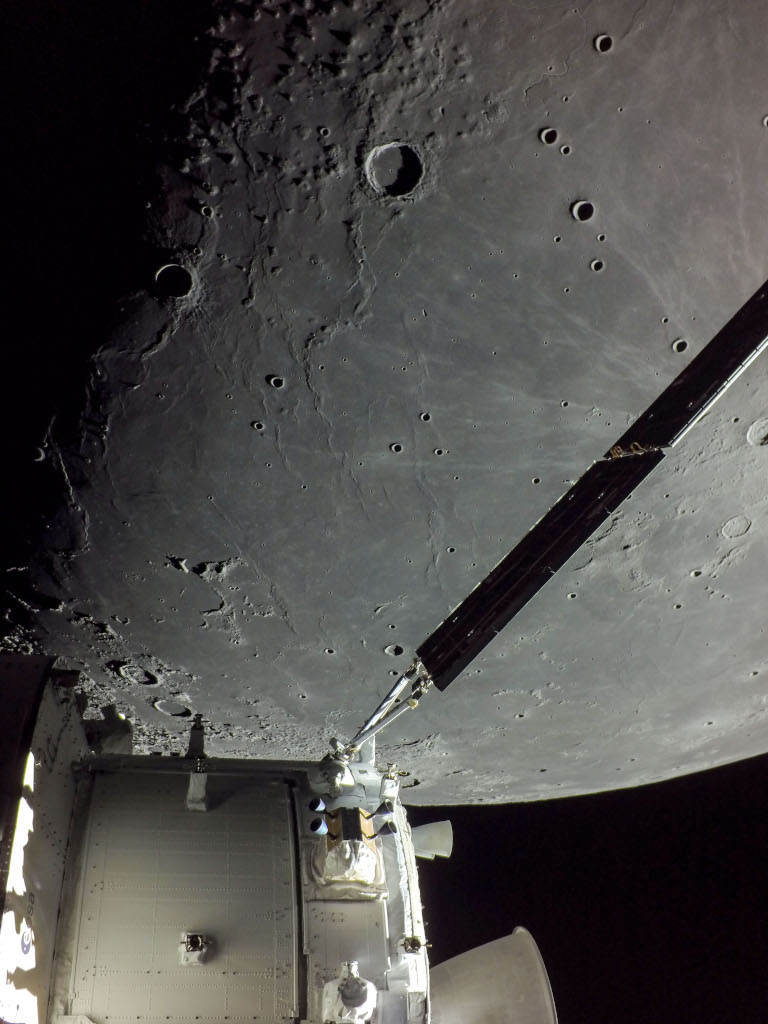
On December 5, 2022, a camera on board the uncrewed Orion spacecraft captured this view as Orion approached its return powered flyby of the Moon. Beyond one of Orion’s extended solar arrays lies dark, smooth, terrain along the western edge of the Oceanus Procellarum. Prominent on the lunar nearside Oceanus Procellarum, the Ocean of Storms, is the largest of the Moon’s lava-flooded maria. The lunar terminator, the shadow line between lunar night and day, runs along the left of this frame. The 41 kilometer diameter crater Marius is top center, with ray crater Kepler peeking in at the edge, just right of the solar array wing. Kepler’s bright rays extend to the north and west, reaching the dark-floored Marius. By December 11, 2022 the Orion spacecraft had returned to its home world. The historic Artemis 1 mission ended with Orion’s successful splashdown in planet Earth’s water-flooded Pacific Ocean. via NASA https://go.nasa.gov/48WvBez
In a Finnish myth, when an arctic fox runs so fast that its bushy tail brushes the mountains, flaming sparks are cast into the heavens creating the northern lights. In fact the Finnish word “revontulet”, a name for the aurora borealis or northern lights, can be translated as fire fox. So that evocative myth took on a special significance for the photographer of this northern night skyscape from Finnish Lapland near Kilpisjarvi Lake. The snowy scene is illuminated by moonlight. Saana, an iconic fell or mountain of Lapland, rises at the right in the background. But as the beautiful nothern lights danced overhead, the wild fire fox in the foreground enthusiastically ran around the photographer and his equipment, making it difficult to capture in this lucky single shot. via NASA https://go.nasa.gov/48QeVW7
https://www.youtube.com/watch/2vciSbKofnI Trump Flails on Inflation & Calls Affordability a “Hoax” as Poll Numbers Hit New Lows: A Closer Look
Seth takes a closer look at Trump saying that the concept of “affordability” is a hoax.
Michael Clarke is here this afternoon to rattle through questions you’ve been sending in. There have been a flurry of developments around Ukraine – including the NATO chief’s remarks just today on preparing for war.
Tune in at 4pm for his insight into those comments and more besides.
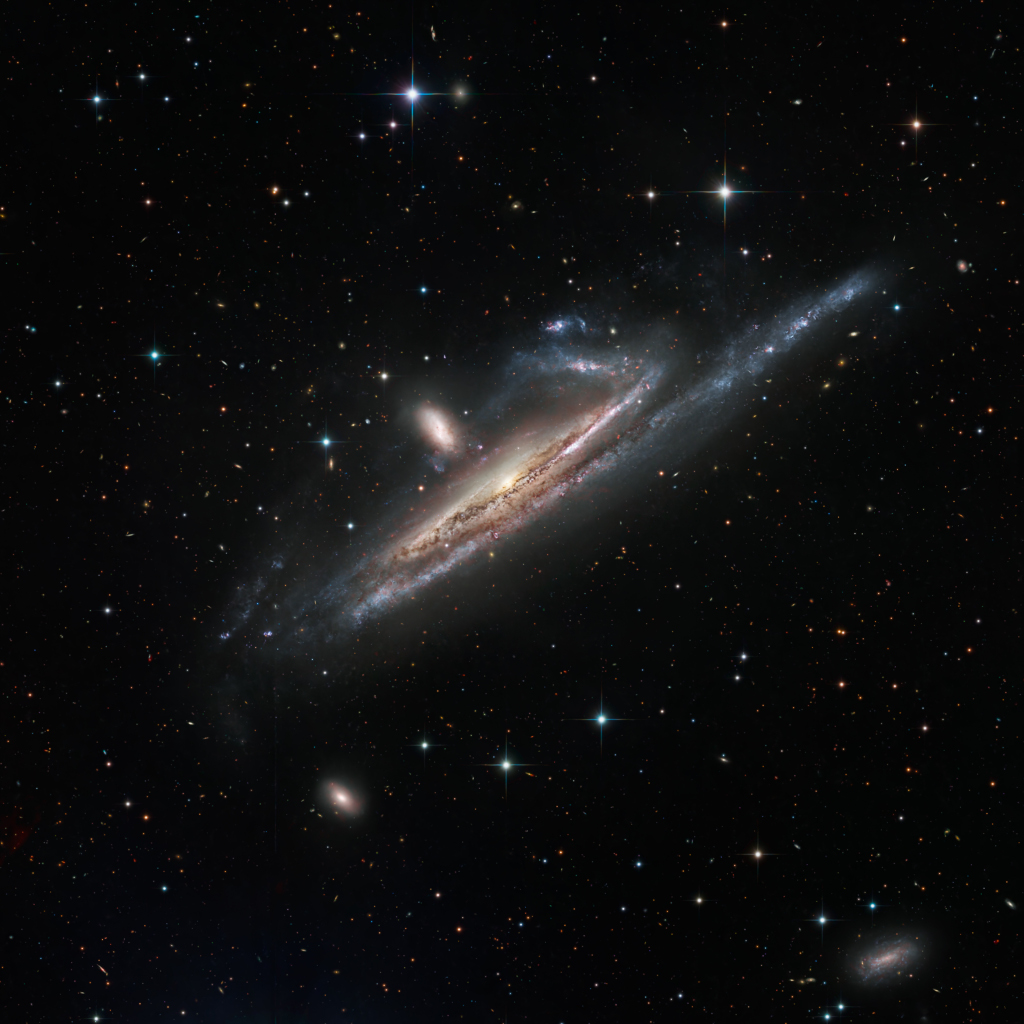
Large galaxies grow by eating small ones. Even our own galaxy engages in a sort of galactic cannibalism, absorbing small galaxies that are too close and are captured by the Milky Way’s gravity. In fact, the practice is common in the universe and illustrated by this striking pair of interacting galaxies from the banks of the southern constellation Eridanus, The River. Located over 50 million light years away, the large, distorted spiral NGC 1532 is seen locked in a gravitational struggle with dwarf galaxy NGC 1531, a struggle the smaller galaxy will eventually lose. Seen nearly edge-on, in this sharp image spiral NGC 1532 spans about 100,000 light-years. The NGC 1532/1531 pair is thought to be similar to the well-studied system of face-on spiral and small companion known as M51. via NASA https://go.nasa.gov/4rRMVtC

 Gatlinburg Garden Castle Rainbow Tower Library Imagination Station Temple Water Spirit Guardian Labyrinth Treasury Magic Healing