Democracy Now! — http://www.democracynow.org
Amy Goodman reports from the U.N.
Vodpod videos no longer available.
1st collector for Pressing the Silence: At U.N. Climate Change Co…
Follow my videos on vodpod
+
+
+
+
+
+
Democracy Now! — http://www.democracynow.org
Amy Goodman reports from the U.N.
Vodpod videos no longer available.
1st collector for Pressing the Silence: At U.N. Climate Change Co…
Follow my videos on vodpod
http://www.democracynow.org
After one week, the fate of negotiations at the U.N. Climate Change Conference remains uncertain.
Vodpod videos no longer available.
1st collector for Climate Talks in Jeopardy as Industrialized Nat…
Follow my videos on vodpod
+
+
+
+
+
+
Democracy Now! — http://www.democracynow.org
Secret diplomatic cables released by WikiLeaks have revealed new details about how the United States manipulated last year’s climate talks in Copenhagen.
Vodpod videos no longer available.
1st collector for Pablo Solón Responds to Secret U.S. Manipulatio…
Follow my videos on vodpod
+
+
+
+
+
+
Melanie Anne Safka-Schekeryk (born February 3, 1947) is an American singer-songwriter.
Usually known professionally as Melanie, she is best known for her hits “Brand New Key”, “Lay Down (Candles in the Rain)” and “What Have They Done To My Song Ma”.
Vodpod videos no longer available.
1st collector for Melanie : Peace Will Come (Live 1971)
Follow my videos on vodpod
http://www.democracynow.org — Watch Part 2: http://www.youtube.com/watch?v=Cjd619X_SZw
After one week, the fate of negotiations at the U.N.
Vodpod videos no longer available.
1st collector for Climate Talks in Jeopardy as Industrialized Nat…
Follow my videos on vodpod
+
+
+
+
+
+
Happy birthday Mick Jagger on the 26th !!
Vodpod videos no longer available.
1st collector for The Rolling Stones – Fool to Cry (HD)
Follow my videos on vodpod
Kate with a wonderful live version from her Christmas TV Special ’79
The Man With The Child In His Eyes
(K Bush)
I hear him, before I go to sleep
And focus on the day that’s been.
I realise he’s there,
When I turn the light off and turn over.
Vodpod videos no longer available.
1st collector for Kate Bush (HD) : The Man With The Child In His …
Follow my videos on vodpod
On the 24th Nov 1991, the world of music lost one of the greatest sons
But he will live on forever through his music, words and performances like this one from Canada 1981
Love of My Life
(Freddie Mercury)
Love of my life,
You hurt me,
You broken my heart,
Now you leave me
Love of my life can’t you see,
Bring it back bring it back,
Don’t take it away from me,
Because you don’t know what it means to me
Love of my life don’t leave me,
You’ve stolen my love you now desert me,
Love of my li
Vodpod videos no longer available.
1st collector for Queen : Love of My Life (Live Montreal ’81) Rem…
Follow my videos on vodpod
“Find out the reason that commands you to write; see whether it has spread its roots into the very depth of your heart; confess to yourself you would have to die if you were forbidden to write.”
– Rainer Maria Rilke
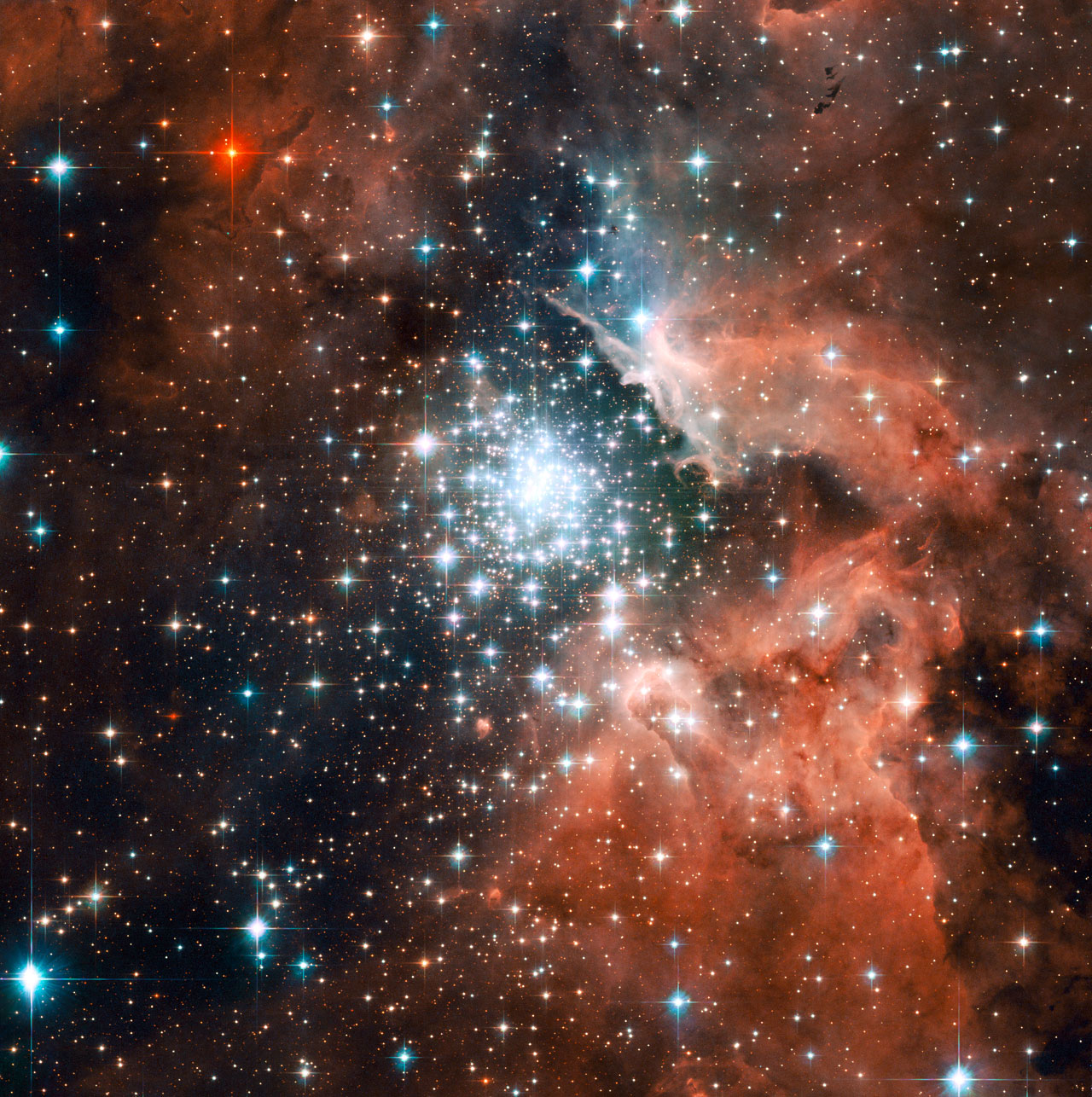
Extreme star cluster bursts into life in new Hubble image
The star-forming region NGC 3603 – seen here in the latest Hubble Space Telescope image – contains one of the most impressive massive young star clusters in the Milky Way. Bathed in gas and dust the cluster formed in a huge rush of star formation thought to have occurred around a million years ago. The hot blue stars at the core are responsible for carving out a huge cavity in the gas seen to the right of the star cluster in NGC 3603’s centre.
Credit:
NASA, ESA and the Hubble Heritage (STScI/AURA)-ESA/Hubble Collaboration
“Be patient toward all that is unsolved in your heart and try to love the questions themselves, like locked rooms and like books that are now written in a very foreign tongue. Do not now seek the answers, which cannot be given you because you would not be able to live them. And the point is, to live everything. Live the questions now. Perhaps you will then gradually, without noticing it, live along some distant day into the answer.”
– Rainer Maria Rilke
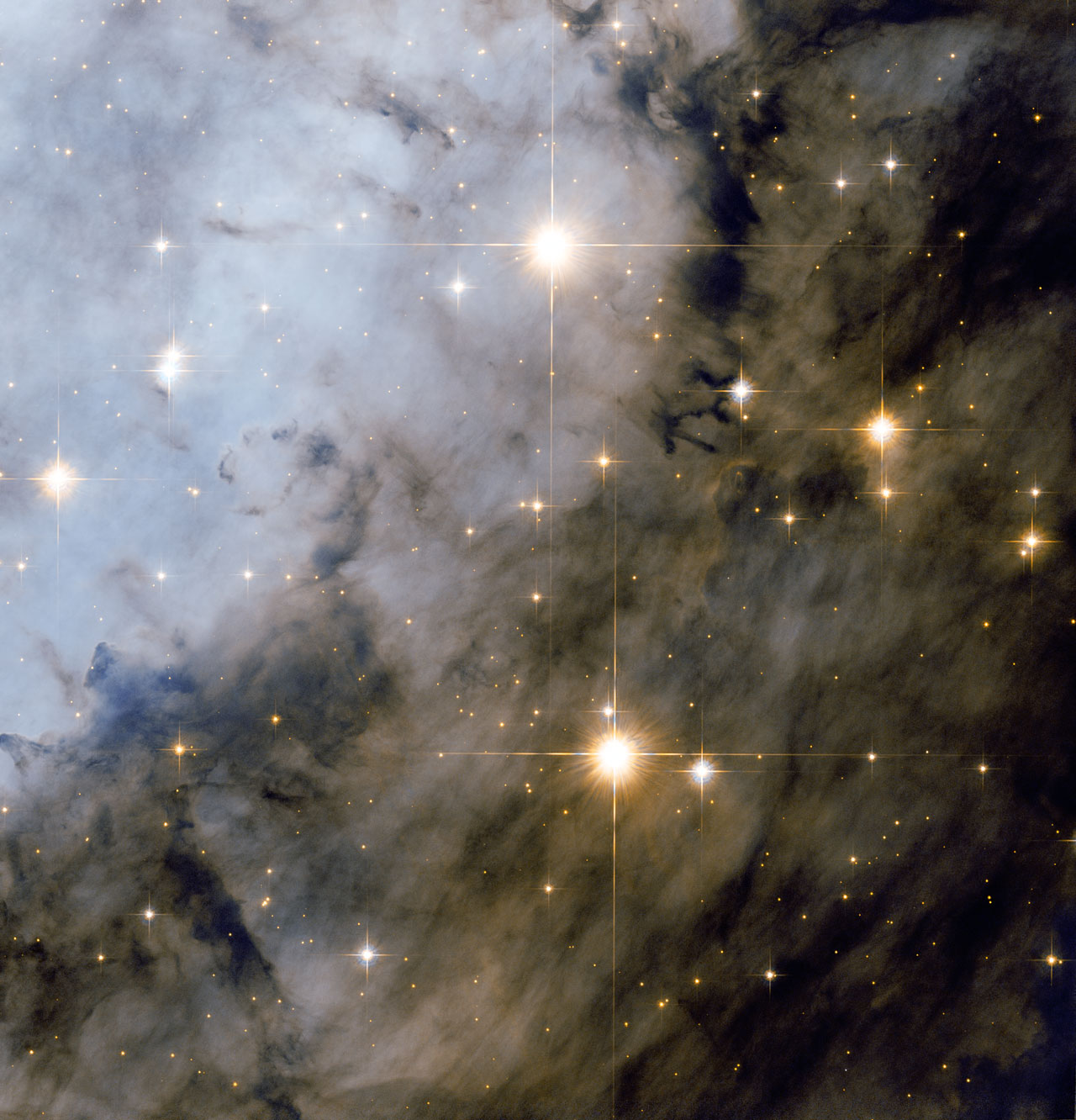
Hubble Peers Deeply into the Eagle Nebula
The NASA/ESA Hubble Space Telescope has once more turned its attention towards the magnificent Eagle Nebula (Messier 16). This picture shows the northwestern part of the region, well away from the centre, and features some very bright young stars that formed from the same cloud of material. These energetic toddlers are part of an open cluster and emit ultraviolet radiation that causes the surrounding nebula to glow.
The star cluster is very bright and was discovered in the mid-eighteenth century. The nebula, however, is much more elusive and it took almost a further two decades for it to be first noted by Charles Messier in 1764. Although it is commonly known as the Eagle Nebula, its official designation is Messier 16 and the cluster is also named NGC 6611. One spectacular area of the nebula (outside the field of view) has been nicknamed “The Pillars of Creation” ever since the Hubble Space Telescope captured an iconic image of dramatic pillars of star-forming gas and dust.
The cluster and nebula are fascinating targets for small and medium-sized telescopes, particularly from a dark site free from light pollution. Messier 16 can be found within the constellation of Serpens Cauda (the Tail of the Serpent), which is sandwiched between Aquila, Sagittarius, and Ophiuchus in the heart of one of the brightest parts of the Milky Way. Small telescopes with low power are useful for observing large, but faint, swathes of the nebula, whereas 30 cm telescopes and larger may reveal the dark pillars under good conditions. But a space telescope in orbit around the Earth, like Hubble — which boasts a 2.4-metre diameter mirror and state-of-the-art instruments — is required for an image as spectacular as this one.
This picture was created from images taken with the Wide Field Channel of Hubble’s Advanced Camera for Surveys. Images through a near-infrared filter (F775W) are coloured red and images through a blue filter (F475W) are blue. The exposures times were one hour and 54 minutes respectively and the field of view is about 3.3 arcminutes across.
Credit:
ESA/Hubble & NASA
+
+
+
+
+
+
+
+
+
+
+
+
+
+
+
+
+
+
“Perhaps all the dragons in our lives are princesses who are only waiting to see us act, just once, with beauty and courage. Perhaps everything that frightens us is, in its deepest essence, something helpless that wants our love.”
– Rainer Maria Rilke
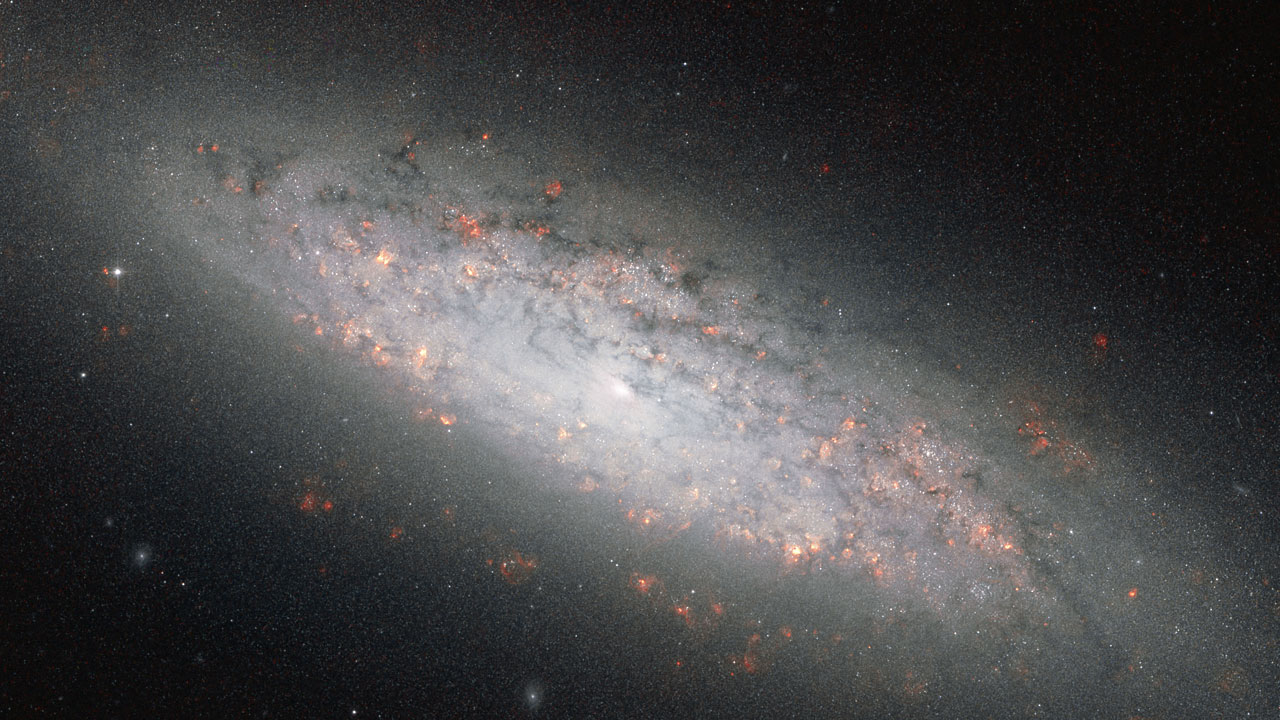
At the Edge of the Abyss
Fresh starbirth infuses the galaxy NGC 6503 with a vital pink glow in this image from the NASA/ESA Hubble Space Telescope. This galaxy, a smaller version of the Milky Way, is perched near a great void in space where few other galaxies reside.
This new image from Hubble’s Advanced Camera for Surveys displays, with particular clarity, the pink-coloured puffs marking where stars have recently formed in NGC 6503’s swirling spiral arms. Although structurally similar to the Milky Way, the disc of NGC 6503 spans just 30 000 light-years, or just about a third of the size of the Milky Way, leading astronomers to classify NGC 6503 as a dwarf spiral galaxy.
NGC 6503 lies approximately 17 million light-years away in the constellation of Draco (the Dragon). The German astronomer Arthur Auwers discovered this galaxy in July 1854 in a region of space where few other luminous bodies have been found.
NGC 6503 sits at the edge of a giant, hollowed-out region of space called the Local Void. The Hercules and Coma galaxy clusters, as well as our own Local Group of galaxies, circumscribe this vast, sparsely populated region. Estimates for the void’s diameter vary from 30 million to more than 150 million light-years — so NGC 6503 does not have a lot of galactic company in its immediate vicinity.
The isolation of NGC 6503 inspired the stargazer Stephen James O’Meara to name it the Lost-In-Space Galaxy in his book Hidden Treasures.
This Hubble image was created from exposures taken with the Wide Field Channel of the Advanced Camera for Surveys. The filters were unusual, which explains the peculiar colour balance of this picture. The red colouration derives from a 28-minute exposure through a filter that just allows the emission from hydrogen gas (F658N) to pass and which reveals the glowing clouds of gas associated with star-forming regions. This was combined with a 12-minute exposure through a near-infrared filter (F814W), which was coloured blue for contrast. The field of view is 3.3 by 1.8 arcminutes.
Credit:
ESA/Hubble and NASA
+
+
+
+
+
+
+
+
+
+
+
+
+
+
+
+
+
+
+
+
+
+
+
+
+
+
+
+
+
+
The Edge
Larry Mullen, Jr.
Bono
Adam Clayton
Also from that set ‘Pride’
Vodpod videos no longer available.
1st collector for U2 : Bad (Live Dublin ’86 – Self Aid) HQ
Follow my videos on vodpod
+
+
+
+
+
+
The band formed in New York in 1967 and still active as of 2010 and have sold over 14 million albums worldwide
(Don’t Fear) The Reaper is taken from their 1976 album, Agents of Fortune. It was written and sung by the band’s lead guitarist, Donald “Buck Dharma” Roeser, produced by Sandy Pearlman, and is built around Dharma’s guitar riff that opens the song and continues throughout.
Vodpod videos no longer available.
1st collector for Blue Öyster Cult : (Don’t Fear) The Reaper
Follow my videos on vodpod
 Gatlinburg Garden Castle Rainbow Tower Library Imagination Station Temple Water Spirit Guardian Labyrinth Treasury Magic Healing